
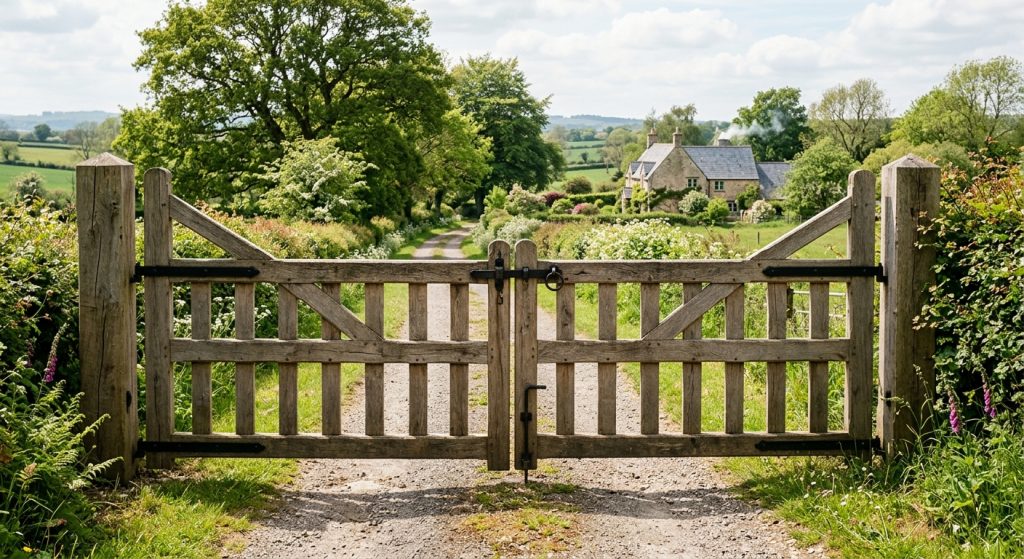
Among commonly available options, well-seasoned white oak and iroko are strong contenders, while teak offers outstanding natural durability and cedar provides a lighter, naturally decay-resistant alternative. The best choice depends not only on species, but also on how the boards are dried, the gate is framed and the timber is protected from standing water.
Timber Gate Warping: The Main Causes and Best Prevention
Timber gate warping occurs when different parts of a board gain or lose moisture at unequal rates. Wood is hygroscopic: it exchanges moisture with the surrounding air, swelling as humidity rises and shrinking as conditions become drier. Because this movement happens more across the grain than along it, a board can cup, twist or bow even when its length changes very little.
Moisture Resistance and Dimensional Stability
Moisture resistance describes how well a species resists water-related decay and deterioration, while dimensional stability refers to how consistently its dimensions respond to changes in moisture. These traits are related but not interchangeable. A wood can resist rot yet still move noticeably as it dries and rewets, so both qualities matter when selecting rot-resistant timber for a gate.
Construction Choices That Limit Movement
Good design helps timber accommodate its natural movement rather than trying to prevent it entirely. A rigid frame, correctly positioned diagonal bracing and sound corner joints reduce the risk of a gate sagging out of square. The vertical boards should follow the grain, and fixings should be suitable for exterior use, with enough support to hold the assembly without splitting the timber.
Species Comparison: Which Timber Resists Warping Best?
No single species is best for every gate. Climate, board dimensions, exposure and construction can change the practical result, and even boards from the same species may vary. The following comparison focuses on characteristics commonly considered for exterior gates; it should be treated as a guide to selection rather than a guarantee that a particular board will remain perfectly straight.
For a substantial gate where strength and movement resistance are priorities, white oak and iroko are strong all-round candidates. Teak is valued for its durability and natural oils, while cedar can suit lighter designs where ease of handling and natural decay resistance matter. Mahogany may also be considered, but the name covers different timbers with differing performance, so its exact species and sourcing should be checked rather than assumed.
| Timber species | Warping-related strengths | Points to consider |
|---|---|---|
| White oak | Dense, strong and suitable for robust frames; heartwood performs well outdoors when detailed correctly. | Its weight calls for substantial posts and hinges, and end grain needs protection. |
| Iroko | A durable stable hardwood often used in exterior joinery; well-selected boards can perform reliably in exposed conditions. | Quality and movement vary with board selection and drying; suitable fixings are important. |
| Teak | Natural oils and strong outdoor durability help it withstand weather exposure. | It is dense and can be heavy; confirm responsible sourcing and plan for appropriate hardware. |
| Cedar | Lightweight and naturally resistant to decay, making it easier to handle in many gate designs. | It is softer than dense hardwoods and can be more vulnerable to dents or impact. |
| Mahogany | Some species offer useful stability and workability for exterior joinery. | Performance depends on the precise species, grade, drying and provenance. |
| Pressure-treated pine | Commonly available and treated to improve resistance to decay and insects. | Treatment does not eliminate movement; boards should be dry and well supported before assembly. |
How to Interpret the Comparison
For a large, solid entrance gate, weight must be considered alongside stability. White oak, iroko and teak can all provide a substantial, durable structure, but a heavy leaf places greater loads on its hinges and posts. If those supporting parts are undersized, the gate may sag even when the boards themselves resist warping well.
Board Quality: Drying, Grain and Timber Selection
Even a naturally durable species can make a troublesome gate if its boards are poorly dried or contain structural weaknesses. Before assembly, the condition of the timber deserves as much attention as its name. A straight board with consistent grain and suitable moisture content is generally more predictable than a warped, knot-heavy piece chosen solely because it belongs to a reputedly stable species.
Grain, Knots and Heartwood
Grain direction influences how a board responds to moisture. Straight-grained material is easier to orient consistently in a framed gate, while irregular or strongly sloping grain can increase the likelihood of distortion and splitting around fixings. Large, loose knots can weaken boards, interrupt the grain and create openings as they dry or deteriorate.
A Practical Timber Inspection
Before purchasing boards, it helps to assess them in a consistent way. The following checks focus on qualities that influence both durability and the likelihood of movement:
- Check straightness: sight along each board to spot bowing, twisting or cupping before it becomes part of the gate.
- Inspect the grain: favour boards with a generally straight, continuous pattern and avoid severe grain run-out near important joints.
- Assess knots and cracks: reject loose knots and substantial splits that could weaken the board or admit water.
- Ask about drying: confirm whether the timber was kiln-dried or air-dried and whether it has been stored under cover.
- Look at the cut ends: check for visible checks and plan to seal end grain after cutting and fitting.
No material can promise zero movement outdoors. The best protection against timber gate warping comes from sound boards, appropriate moisture resistance, a braced frame, adequate hardware and protection from trapped water. A gate built around those principles is far more likely to stay aligned, open smoothly and retain its character through changing weather.


